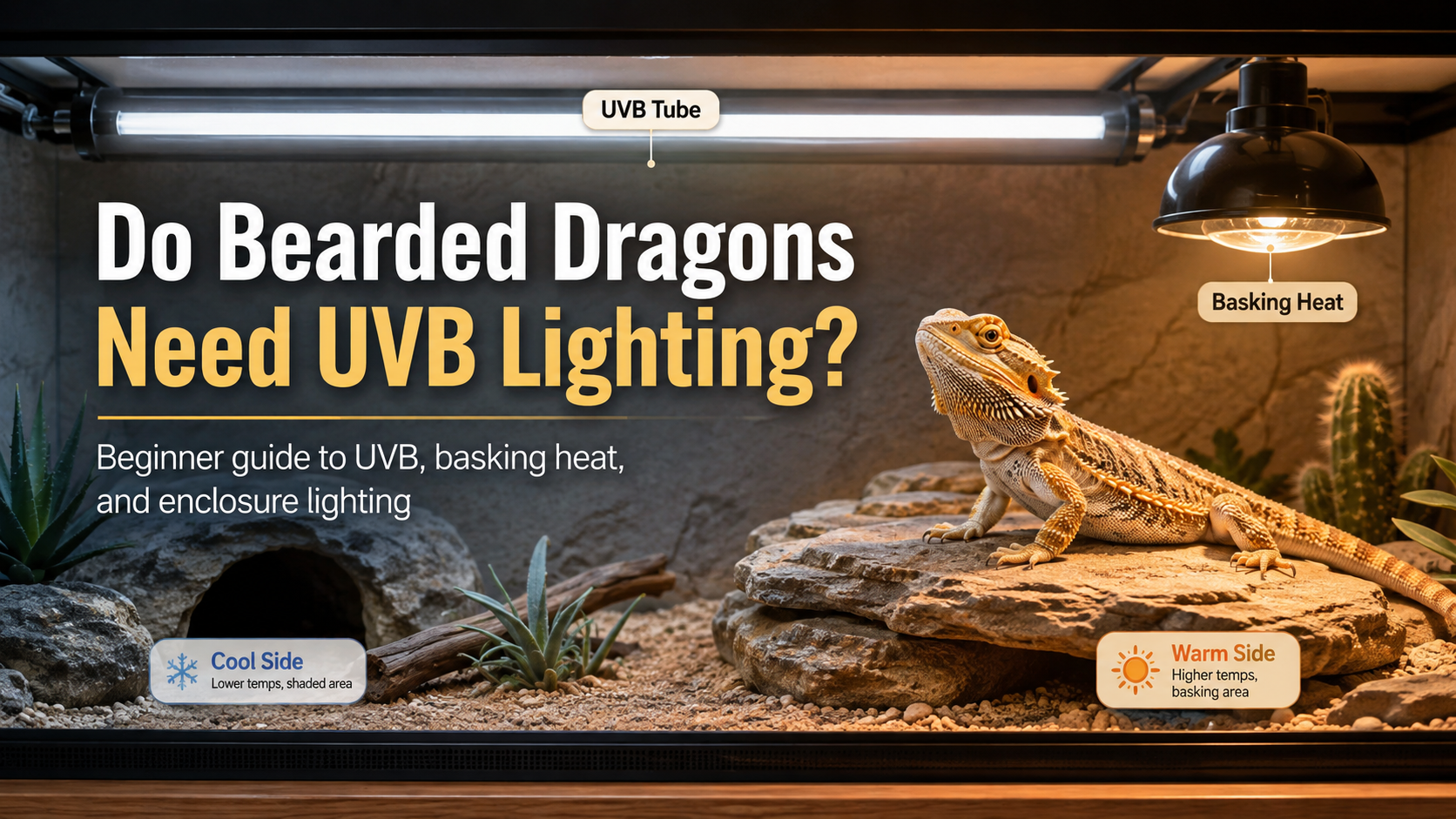
Yes. Bearded dragons need UVB lighting as part of an appropriate indoor habitat setup.
Heat helps a bearded dragon warm up and creates a basking zone, but heat alone is not enough. UVB lighting allows bearded dragons to produce vitamin D3 in the skin, and vitamin D3 supports normal calcium storage and use. The RSPCA bearded dragon care guide explains this relationship between UVB, vitamin D3, and calcium use.
The beginner takeaway: a bearded dragon needs both heat and UVB. A basking bulb is not the same thing as a UVB light.
Why UVB Matters for Bearded Dragons
In the wild, bearded dragons receive sunlight. Sunlight contains visible light, UVA, and UVB. Indoors, glass windows block UVB, so placing an enclosure near a sunny window does not replace a suitable reptile UVB lamp. The RSPCA specifically notes that UVB does not pass through glass windows and recommends using a reptile UVB lamp within the vivarium.
Within a carefully planned enclosure, UVB supports:
- Vitamin D3 production
- Normal calcium storage and use
- A natural daytime lighting cycle
- A light-to-shade gradient that allows the animal to move between zones
UVB is one part of husbandry rather than a stand-alone solution. Diet, supplementation, enclosure design, temperature, lamp placement, and regular observation still need to be planned together. Concerns about an animal's condition should be discussed with a reptile veterinarian.
Heat Bulb vs. UVB Light: What's the Difference?
This is one of the most common points of confusion for beginners. A heat bulb and a UVB lamp have different jobs, and one should not be treated as a replacement for the other.
| Equipment | Main purpose | Important distinction |
|---|---|---|
| Basking heat bulb | Creates warmth and a focused basking area | Most standard basking bulbs do not provide the UVB exposure the enclosure needs |
| Linear UVB tube | Provides UVB exposure across a planned zone | It does not replace a controlled basking heat source |
PetMD's bearded dragon care sheet also separates heat and UVB requirements, recommending suitable heat together with full-spectrum UVB lighting.
What Type of UVB Light Should a Bearded Dragon Use?
For most modern bearded dragon setups, a linear fluorescent UVB tube is generally preferred over a small compact bulb because it can create a broader, more usable UVB zone.
The RSPCA recommends a high-output 10–12% UVB fluorescent tube positioned toward the basking zone and paired with a suitable reflector. It also recommends creating a light-to-shade gradient so the bearded dragon can move between brighter and more shaded areas.
ReptiFiles recommends T5 HO linear fluorescent UVB for bearded dragons and lists examples such as Arcadia T5 HO Desert 12% and Arcadia T5 HO Dragon 14%. It emphasizes that appropriate placement depends on the lamp, fixture, distance, and any mesh obstruction.
For a beginner-friendly setup, use a high-quality linear T5 HO UVB tube intended for desert reptiles, pair it with a compatible reflector fixture, and follow the manufacturer's placement instructions for that exact lamp and enclosure.
Where Should the UVB Light Be Placed?
UVB placement matters. A suitable lamp placed too far away may not provide the intended exposure, while a high-output lamp placed too close may produce a stronger zone than planned.
A bearded dragon enclosure should generally create a UVB gradient:
- The strongest planned UVB near the basking area
- Lower UVB toward the shaded side
- Deep shade or a hide where the animal can move away from the light
The RSPCA recommends positioning the UVB light toward the basking zone and creating a photogradient from light to shade. Its care guidance describes a UV Index gradient of approximately 3.0–5.0 in the basking zone to zero in deep shade, while noting that some morphs may require different levels.
Because output varies by fixture, reflector, bulb brand, distance, mesh, and enclosure height, avoid guessing. Follow the lamp manufacturer's placement chart and seek qualified help when the enclosure does not match the examples in that guidance.
Does the UVB Light Go Above or Below the Mesh?
The answer depends on the lamp, fixture, screen material, enclosure height, and distance from the bulb to the animal's back at the basking position.
Mesh can reduce UVB exposure, so a lamp placed on top of a screen lid may require different distance planning than one mounted inside the enclosure. ReptiFiles emphasizes that UVB output changes with distance and mesh obstruction.
For a beginner setup:
- Choose a reputable T5 HO UVB kit.
- Read the manufacturer's placement instructions for the exact lamp and fixture.
- Account for whether the UVB lamp is above or below mesh.
- Do not place glass or plastic between the lamp and the bearded dragon.
- Use a compatible reflector fixture.
Glass and plastic block UVB, so a lamp can look bright while failing to deliver the intended UVB through those materials.
How Long Should UVB Be On Each Day?
Bearded dragons need a clear day-and-night cycle.
A common beginner schedule is about 10–12 hours of UVB and visible light during the day, followed by darkness at night. PetMD recommends 10–12 hours of UVB each day, while the RSPCA describes a simple timer schedule of 12 hours on during the day and 12 hours off at night.
A timer helps keep the lighting routine consistent. Avoid leaving bright lights on overnight.
How Often Should You Replace a UVB Bulb?
UVB output decreases over time even when a lamp still produces visible light.
The RSPCA recommends checking UV levels regularly and replacing the lamp according to the manufacturer's instructions. PetMD likewise notes that visible brightness does not confirm the remaining UVB output.
A simple beginner rule is to follow the manufacturer's replacement schedule rather than judging the lamp by appearance. If you use a suitable reptile UV Index meter, follow its instructions carefully and compare readings with qualified placement guidance.
Common Beginner UVB Mistakes
Mistake 1: Thinking a heat bulb provides UVB
Most regular basking bulbs provide heat and visible light, not the planned UVB zone. Heat and UVB should be selected and positioned separately.
Mistake 2: Using a small compact UVB bulb for a large enclosure
A small compact bulb may not create a broad UVB zone across the basking area. A suitable linear UVB tube is generally a more practical choice for a bearded dragon enclosure.
Mistake 3: Putting UVB behind glass or plastic
Glass and plastic block UVB, so the lamp may look bright while providing little or no useful UVB through the barrier.
Mistake 4: Ignoring distance
UVB strength changes with distance. Follow the recommendations for the exact bulb, fixture, reflector, mesh, and enclosure arrangement.
Mistake 5: Forgetting the cool shaded side
A bearded dragon should be able to move away from strong light. Plan a photogradient from the brighter basking zone to deep shade.
Mistake 6: Never replacing the UVB bulb
A UVB lamp can still glow while producing less UVB than it did when new. Follow the manufacturer's replacement schedule and monitoring guidance.
A Simple Beginner UVB Setup
The lighting, heating, and monitoring portion of a beginner bearded dragon setup commonly includes:
- A basking heat bulb positioned on one side
- A compatible ceramic-socket heat-lamp fixture
- A linear T5 HO UVB tube intended for the enclosure and species
- A compatible reflector fixture
- A timer for the day-and-night cycle
- A warm basking area with an appropriate lamp-to-animal distance
- A cooler shaded side and deep shade or hide
- Digital thermometers for warm-side and cool-side monitoring
- An infrared thermometer for basking-surface checks
Beginner setup checklist:
- Confirm that the heat bulb and UVB tube are separate, compatible tools.
- Check the manufacturer's UVB distance chart.
- Account for mesh and remove any glass or plastic UVB barrier.
- Align the stronger UVB zone with the basking side.
- Preserve a cooler, shaded escape area.
- Set a consistent daytime timer schedule.
- Measure warm-side, cool-side, and basking-surface temperatures.
- Test and observe the complete setup before regular use.
The goal is not simply to make the enclosure bright. The goal is to coordinate heat, UVB, visible light, shade, and temperature monitoring so each part has a clear role.
Organizing these systems for the first time? The Bearded Dragon Heating & UVB Starter Kit provides a coordinated starting point for the heat, UVB, and temperature-monitoring portion of the setup. It is not a complete habitat bundle.
Review the Setup Before Use
Before regular use, confirm the lamp model, fixture, reflector, distance, mesh position, timer schedule, temperature gradient, and shaded retreat. Recheck the setup after changing a bulb, fixture, enclosure, basking height, or screen lid because each change can affect light or heat at the animal's position.
Continue using species-specific care guidance and consult a reptile veterinarian or qualified reptile specialist when you have questions about the animal or an enclosure that falls outside standard setup examples.
Need a clearer equipment starting point? Explore the Bearded Dragon Heating & UVB Starter Kit. It supports heat, linear UVB, and temperature monitoring, but it does not include the enclosure, substrate, hides, feeding supplies, décor, or live animal and does not replace species-specific research or reptile veterinarian advice.
Frequently Asked Questions
Do bearded dragons really need UVB?
Yes. Bearded dragons need appropriate UVB lighting indoors. UVB allows them to produce vitamin D3, which supports normal calcium storage and use.
Can a bearded dragon get UVB through a window?
No. Glass blocks UVB, so a sunny window is not a replacement for an appropriately selected and positioned reptile UVB lamp.
Is a heat lamp the same as a UVB lamp?
No. A heat lamp creates warmth and a basking area. A UVB lamp provides ultraviolet light. Most indoor setups need both systems planned separately.
What UVB strength should I use for a bearded dragon?
Many bearded dragon setups use a high-output 10–12% linear UVB tube, but the appropriate choice and distance depend on enclosure height, fixture type, reflector, mesh, bulb brand, and the animal's basking position. Follow the manufacturer's guidance for the exact equipment.
How long should UVB be on each day?
A common schedule is about 10–12 hours during the day, with the lights off at night. A timer can help maintain a consistent day-and-night cycle.
When should I replace a UVB bulb?
Follow the manufacturer's replacement schedule. UVB output decreases over time even when the lamp still appears bright.