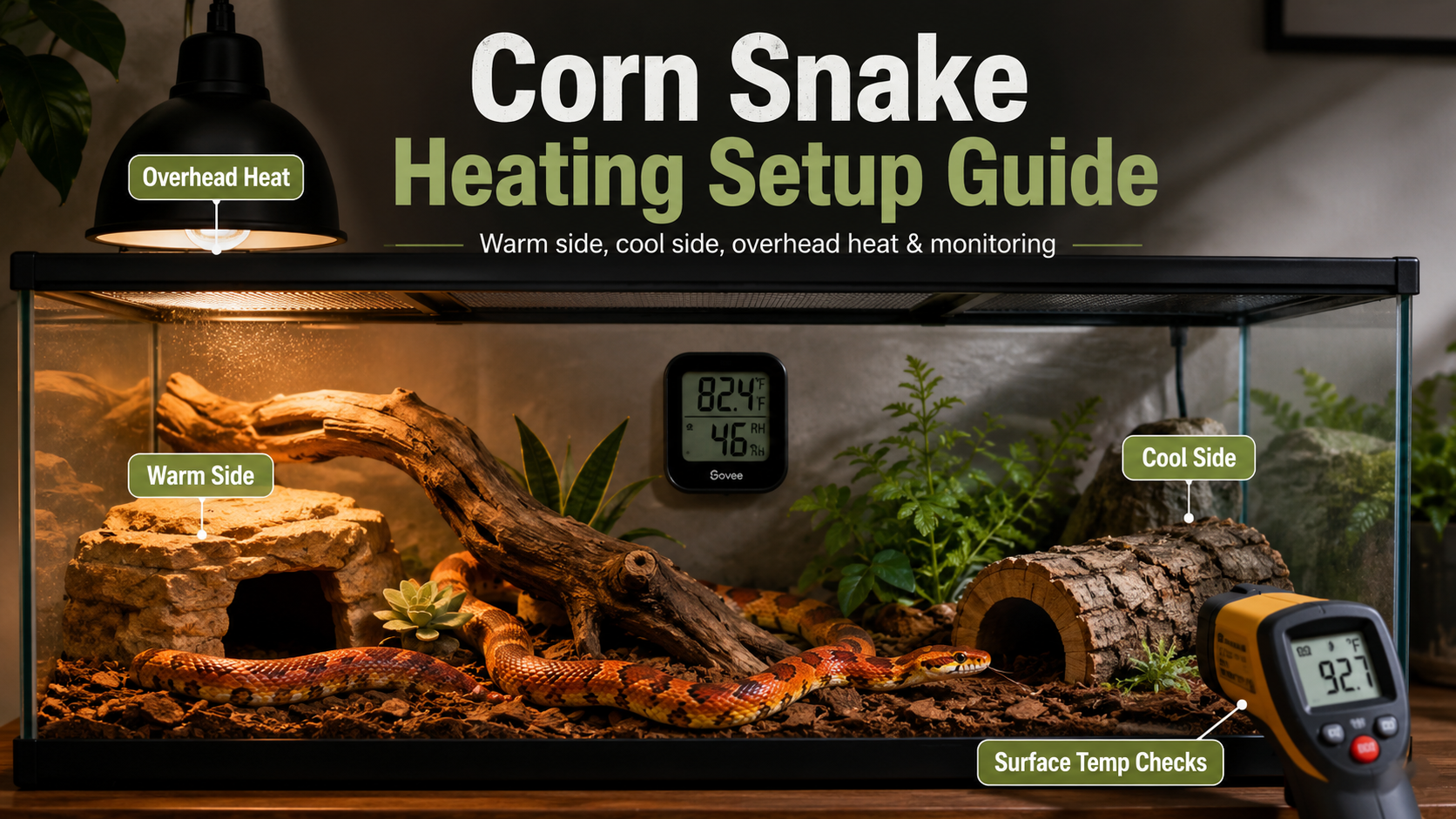
Setting up heat for a corn snake is not about making the whole enclosure equally warm. A practical corn snake heating setup creates a temperature gradient: a warmer side where the snake can warm up and a cooler side where it can retreat.
Corn snakes are ectothermic reptiles, so they rely on environmental heat and move between temperature zones as needed. VCA Animal Hospitals explains that a snake enclosure should provide a heat gradient rather than one uniform temperature.
This guide focuses on a corn-snake-specific workflow using controlled overhead heat, controller and probe placement, air and humidity monitoring, and surface temperature checks. For a broader overview that applies across several snake setups, see Snake Enclosure Heating Setup Guide for Beginners.
Quick Answer: What Does a Corn Snake Heating Setup Need?
| Setup part | Purpose |
|---|---|
| Overhead heat bulb | Creates a focused daytime warm side |
| Heat-safe E27 lamp holder | Supports the compatible heat bulb securely |
| Thermostat or heat controller | Helps regulate heat output through a correctly placed probe |
| Digital thermometer-hygrometer | Tracks enclosure air temperature and humidity |
| Infrared surface thermometer | Spot-checks warm-side surfaces |
| Warm hide and cool hide | Provide secure choices across the gradient |
| Secure enclosure | Supports stable conditions and prevents escapes |
Published care guides differ slightly on exact targets and measurement methods. PetMD describes a warm end around 85°F and a cool end in the low 70s°F, while ReptiFiles describes a warmer basking surface and a cool zone. The practical takeaway is to create both zones, compare current care guidance, and test the actual enclosure before regular use.
1. Create a Warm Side and a Cool Side
Place the heat source above one end of the enclosure rather than in the center. This makes it easier to establish a warm side while preserving a cooler retreat at the opposite end.
A simple layout includes:
- A warm hide on the heated side
- A cool hide on the opposite side
- The overhead lamp above one end
- A digital monitor positioned to track enclosure air conditions
- An infrared thermometer for surface spot checks
- Water, cover, and décor arranged so the snake can move naturally between zones
The goal is choice. The snake should not be forced to remain at one temperature throughout the day.
2. Use Controlled Overhead Heat
This article focuses on controlled overhead heat because an overhead lamp can warm the air and the surfaces beneath it. ReptiFiles discusses halogen and incandescent bulbs as overhead options for creating a warm zone.
A beginner workflow uses a compatible halogen heat bulb, a heat-safe lamp holder, a controller or thermostat, a carefully positioned probe, and monitoring tools. The controller does not eliminate the need to test the enclosure; it is one part of the control and verification process.
The Corn Snake Heat Control & Temperature Monitoring Starter Kit is organized around controlled overhead warmth, ambient monitoring, and independent surface checks.
3. Heat Mats Are Different From Overhead Heat
Heat mats and overhead lamps do not warm an enclosure in the same way. This guide does not claim that one method works for every enclosure. Any heat source should be compatible with the enclosure, controlled appropriately, and monitored carefully.
PetMD notes that an under-tank heater, when used, should be connected to a thermostat. The current ReptiCore corn snake kit does not include a heat mat; it focuses on controlled overhead heat.
4. Monitor Air Conditions and Surface Temperatures
One reading does not describe the entire enclosure. Use a digital thermometer-hygrometer with a remote probe to track enclosure air temperature and humidity, then use an infrared thermometer to spot-check surfaces.
Useful surface checks may include:
- The warm-hide roof or entrance area
- A branch, slate, or rock beneath the lamp
- Substrate on the heated side
- Comparable surfaces on the cool side
Surface temperature can differ from the surrounding air, which is why ambient monitoring and surface temperature checks serve different purposes.
5. Place the Controller Probe Carefully
If the setup uses a temperature controller, probe placement matters. Position the probe at the intended warm-side control point and secure it so the snake cannot move it into a misleading location.
- Install the 35W PAR30 halogen bulb in the compatible E27 deep-dome lamp holder.
- Position the overhead lamp above the warm side.
- Place and secure the controller probe at the chosen warm-side control point.
- Position the digital thermometer-hygrometer to track enclosure conditions.
- Compare those readings with infrared surface spot checks.
- Adjust the setup and test it again before regular use.
Do not place the probe randomly. A controller can respond only to the temperature measured where its probe is located.
6. Test Before Regular Use
Do not assume the setup is correct just because each component powers on. Final conditions change with:
- Enclosure size and height
- Room temperature
- Ventilation and mesh density
- Lamp distance and bulb wattage
- Substrate type and depth
- Hide and décor placement
- Controller probe placement
Run the completed system, check readings at different times, and adjust before relying on it for daily care. Retest after changing the bulb, enclosure, lamp position, substrate, ventilation, or room conditions.
7. Plan for Nighttime Conditions
Corn snakes need a normal day-and-night cycle, so a visible halogen lamp should not remain on overnight. Check the actual nighttime room and enclosure temperatures instead of assuming additional heat is necessary.
ReptiFiles advises against nighttime colored bulbs. If species-specific guidance and measured room conditions indicate that nighttime heat is needed, choose a suitable non-light-emitting source, control it appropriately, and continue monitoring.
8. What This Setup Does Not Include
A heating system is only one part of a corn snake habitat. The ReptiCore kit does not include the enclosure, substrate, warm hide, cool hide, humid hide, water dish, décor or clutter, food, feeding tools, UVB lighting, or live animal.
Petco’s corn snake care guide also discusses the broader habitat needs, including a secure enclosure, hiding areas, décor, and a temperature gradient. Treat the heating kit as a starter system rather than a complete habitat bundle. Browse Snake Habitat Setup for related setup resources.
Common Corn Snake Heating Mistakes
Heating the whole enclosure evenly
A corn snake needs access to warmer and cooler zones, not one flat temperature everywhere.
Placing the heat source in the center
Positioning the lamp toward one end makes a usable gradient easier to establish.
Using heat without compatible control
Use an appropriate controller or thermostat for the chosen heat source, then verify the result with independent monitoring.
Checking only air temperature
Air and surface readings can differ. Check enclosure air conditions and warm-side surfaces separately.
Placing or securing the probe poorly
A misplaced probe can cause the controller to respond to the wrong location.
Forgetting the cool hide
A secure cool-side retreat is part of the temperature-gradient plan.
Leaving visible heat lamps on overnight
Visible daytime lamps should switch off for the night cycle.
Copying another enclosure without testing
The same bulb can behave differently as enclosure size, room temperature, ventilation, mesh, lamp distance, substrate, and probe placement change.
Beginner Corn Snake Heating Setup Checklist
Before regular use, confirm that you have:
- Overhead heat positioned on one side
- A distinct warm side and cool side
- A warm hide and cool hide
- A secure enclosure with a locking lid
- A compatible heat controller or thermostat
- A correctly placed and secured controller probe
- A digital thermometer-hygrometer with remote probe
- An infrared thermometer for surface checks
- Warm-side, cool-side, and surface readings checked over time
- Nighttime temperatures checked with visible lights off
- The complete system tested before regular use
- Current species-specific care guidance reviewed
Build the enclosure first, test the complete system carefully, and adjust it before relying on it for daily care.
How the ReptiCore Starter Kit Fits Into the Setup
The starter kit includes four coordinated components:
- 35W PAR30 Halogen Heat Bulb
- E27 Deep-Dome Lamp Holder with controller support
- Black Digital Thermometer-Hygrometer with Remote Probe
- Infrared Surface Thermometer
These components support controlled overhead heat, enclosure air and humidity monitoring, and surface temperature checks. You will still need the rest of the habitat and species-specific research.
Review the coordinated components: Visit the Corn Snake Heat Control & Temperature Monitoring Starter Kit. Test and adjust the complete enclosure before regular use.
Frequently Asked Questions
What is a practical heating setup for a corn snake?
A practical beginner setup creates a warm side and a cool side using a controlled heat source above one end, plus independent air and surface monitoring.
Do corn snakes need a heat lamp?
Corn snakes need an appropriate heat source and a temperature gradient. An overhead lamp is one way to create the warm side, but the final arrangement must be tested and adjusted for the enclosure.
Should I use overhead heat or a heat mat?
This guide focuses on controlled overhead heat. Other methods have different installation and control requirements; no single method should be assumed to work for every enclosure.
What temperature should the warm side be?
Published care guides use somewhat different targets and measurement points. Compare current corn snake care references, identify whether a number refers to air or surface temperature, and verify the actual warm and cool zones in your enclosure.
Do I need both monitoring tools?
They answer different questions. The digital thermometer-hygrometer tracks enclosure air conditions, while the infrared thermometer provides quick surface spot checks.
Can I leave the halogen lamp on at night?
Do not leave a visible halogen lamp on overnight. Check measured nighttime conditions and use an appropriate non-light-emitting heat source only when current species guidance and the enclosure conditions indicate it is needed.
Does this kit include UVB lighting?
No. UVB lighting is not included in the Corn Snake Heat Control & Temperature Monitoring Starter Kit.
Is this a complete corn snake habitat?
No. It is a starter system for overhead heat control and temperature monitoring, not a complete habitat bundle.