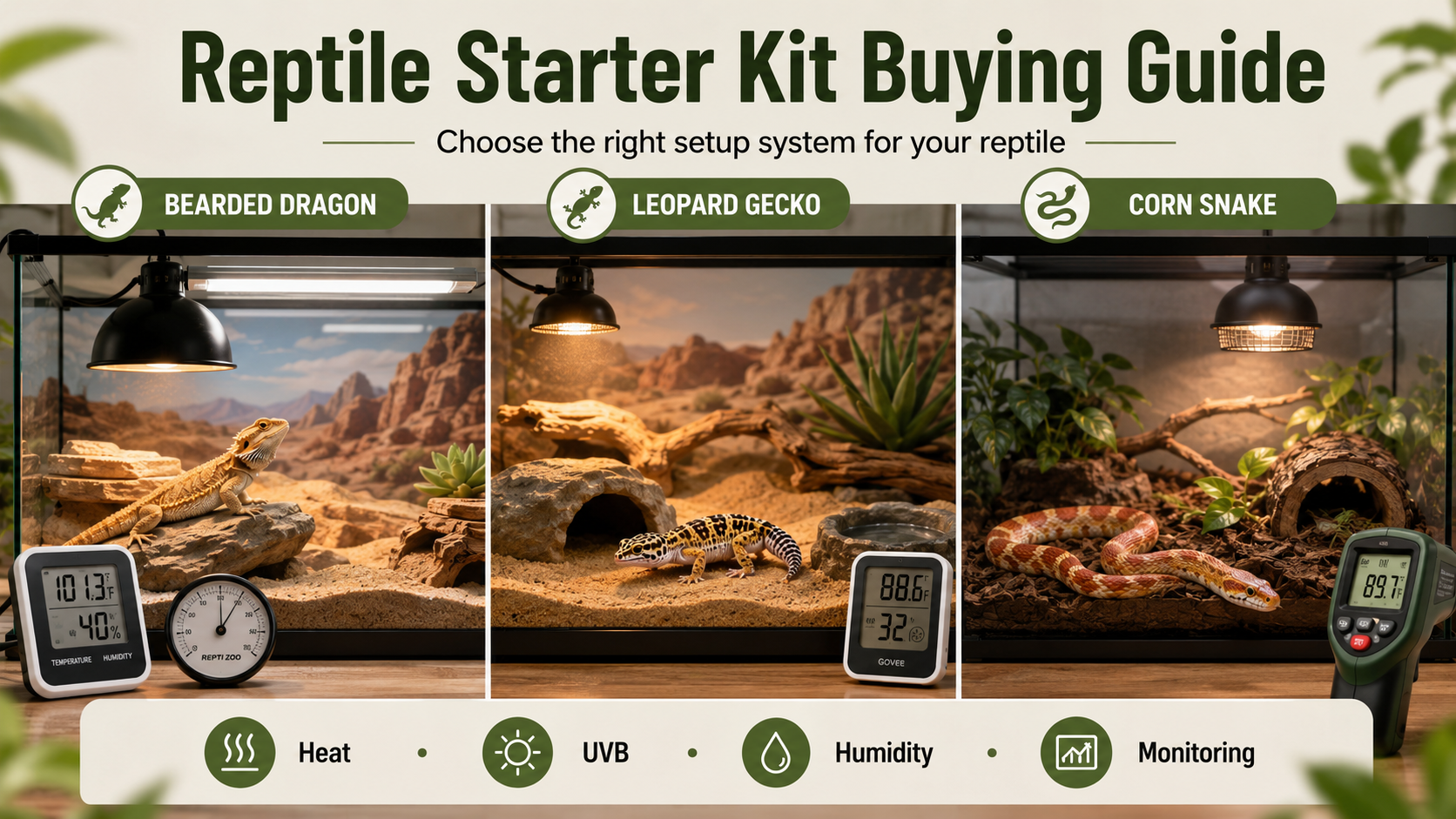
Buying a reptile starter kit can make setup feel easier, but not every “starter kit” means the same thing.
Some kits include an enclosure. Others focus on lighting, heating, humidity, or monitoring. Generic bundles can leave beginners unsure whether the parts actually match the animal they plan to keep.
A useful starter kit should solve a defined setup problem rather than simply combine unrelated supplies. This guide explains how to compare focused systems for bearded dragons, leopard geckos, and corn snakes while keeping species needs and kit limitations clear.
Quick Answer: What Should You Look for in a Reptile Starter Kit?
| Setup need | Why it matters |
|---|---|
| Heat | Reptiles need species-appropriate warmer and cooler zones |
| UVB | Some reptiles need a correctly selected and positioned UVB system |
| Humidity | Ambient and localized moisture needs differ greatly by species |
| Monitoring | Thermometers, hygrometers, and surface checks reduce guesswork |
| Species fit | A bearded dragon setup is not the same as a leopard gecko or corn snake setup |
| Clear exclusions | The buyer should know what still needs to be selected separately |
Many reptiles need a temperature gradient rather than one flat temperature. The RSPCA corn snake care guide, for example, describes placing heat toward one end so the animal can move between warmer and cooler zones.
1. Start With the Species, Not the Kit
The biggest buying mistake is choosing a bundle first and trying to fit the reptile’s needs around it. Select the species, review current care guidance, and then choose equipment that supports that animal and the planned enclosure.
- Bearded dragons: focused daytime basking heat, suitable linear UVB, and temperature monitoring
- Leopard geckos: a warm-to-cool gradient, relatively dry ambient conditions, and a localized humid hide
- Corn snakes: a secure enclosure, controlled warm side, cooler retreat, and reliable air and surface checks
The practical rule is simple: choose the reptile first, then choose the setup system that matches the species and enclosure.
2. Understand What a Starter Kit Is and Is Not
A reptile starter kit is usually not a complete habitat. Many kits still require an enclosure, substrate, hides, water dish, décor, food, supplements, cleaning supplies, and species-specific research.
ReptiCore starter kits are focused systems designed to support particular setup areas:
- Heating and heat control
- UVB lighting
- Humidity support
- Temperature and humidity monitoring
- Surface temperature checks
A clear product page should identify both the included components and the important items still needed.
3. Check the Heating System
The better buying question is not only “Does this include a heat source?” Ask whether the system can help create a usable warm side and cool side for the selected species.
Before buying a heating kit, check:
- The heat-source type and wattage
- Whether the lamp holder is compatible and heat-safe
- Whether a thermostat, controller, or manual dimmer is included
- What the control device can and cannot do
- Which monitoring tools are included
- Which enclosure factors still require testing
For a detailed example of lamp positioning and temperature verification, read Bearded Dragon Heating Setup for Beginners. The broader Snake Enclosure Heating Setup Guide for Beginners explains warm-side planning across snake enclosures.
4. Check Whether UVB Is Included or Needed
A basking heat bulb is not automatically a UVB bulb. Heat and UVB have different roles and should be evaluated separately.
For bearded dragons, indoor care includes suitable UVB. The RSPCA bearded dragon guidance discusses a UVB gradient from the basking zone toward shade. Recommendations for other reptiles vary, so species-specific research remains necessary.
Before buying, ask:
- Is UVB included, optional, or not included?
- What tube or bulb and reflector fixture are supplied?
- What placement and distance instructions apply?
- How do mesh, glass, enclosure height, and shade affect the arrangement?
- When should the lamp be replaced?
For the installation workflow rather than a general explanation of need, see Bearded Dragon UVB Setup Guide.
5. Check Humidity and Shedding Support
Humidity needs vary widely. A bearded dragon enclosure, a leopard gecko enclosure, and a tropical gecko enclosure should not use one generic humidity plan.
Leopard geckos generally need a relatively dry main enclosure with a localized humid hide. A hygrometer and a well-designed moist hide support different parts of that plan. Read the Leopard Gecko Temperature and Humidity Guide for the full warm-side, cool-side, and humid-hide workflow.
When comparing kits, check whether the product includes ambient humidity monitoring, a humid hide or tray, and clear guidance about what remains separate. Do not assume that a generic misting or humidity bundle suits the selected species.
6. Look for Monitoring Tools
Monitoring tools help beginners replace assumptions with measured conditions. Depending on the species and setup goal, useful tools can include:
- Digital thermometers
- Digital hygrometers
- Probe thermometers
- Dual-sensor thermometer-hygrometers
- Infrared surface thermometers
A digital monitor tracks enclosure air conditions, while an infrared thermometer checks selected surfaces. The surface beneath a lamp can differ from the surrounding air, so the two methods should not be treated as interchangeable.
PetMD’s corn snake care sheet describes checking warm and cool areas and using a point-and-shoot thermometer for immediate readings. The corn-snake-specific workflow is covered in Corn Snake Heating Setup Guide.
7. Compare Kits by Setup Goal
Instead of asking which kit has the most items, ask what setup problem each kit is designed to solve.
| Reptile | Main beginner concern | Focused kit direction |
|---|---|---|
| Bearded dragon | Heat, UVB, and temperature monitoring | Heating and UVB starter system |
| Leopard gecko | Warm side, humidity monitoring, surface checks, and humid hide | Heating and humidity monitoring system |
| Corn snake | Controlled warm side and independent surface checks | Heat control and monitoring system |
This setup-goal approach makes it easier to compare useful functions instead of counting components.
8. ReptiCore Starter Kit Comparison
Bearded Dragon Heating & UVB Starter Kit
Best suited to beginners organizing the basking heat, linear UVB, and temperature-monitoring portion of a bearded dragon habitat.
It supports a white basking heat source, adjustable lamp, T5 HO UVB tube and reflector fixture, plus warm-side and cool-side monitoring. It does not include the enclosure, substrate, hides, basking platform, décor, feeding supplies, supplements, infrared temperature gun, automatic thermostat, or live animal.
Bearded Dragon Heating & UVB Starter Kit
Leopard Gecko Heating & Humidity Monitoring Starter Kit
Best suited to beginners organizing controlled daytime warmth, air and humidity monitoring, independent surface checks, and a localized moist hide.
It includes a PID dimming controller and six coordinated components. It does not include the enclosure, substrate, dry hides, water dish, décor, feeding supplies, supplements, UVB lighting, or live animal.
Leopard Gecko Heating & Humidity Monitoring Starter Kit
Corn Snake Heat Control & Temperature Monitoring Starter Kit
Best suited to beginners organizing controlled overhead heat, ambient monitoring, and surface temperature verification for a corn snake warm-side setup.
It does not include the enclosure, substrate, warm hide, cool hide, humid hide, décor, water dish, food, UVB lighting, heat mat, or live animal.
Corn Snake Heat Control & Temperature Monitoring Starter Kit
9. What Most Reptile Starter Kits Do Not Include
Read exclusions before buying. Many focused systems do not include:
- Enclosure and secure lid
- Species-appropriate substrate
- Warm, cool, or humid hides
- Water and food dishes
- Décor, cover, or climbing structures
- Food, supplements, and feeding tools
- Timers or every possible control device
- Cleaning supplies
- Veterinary care
- Species-specific research
- A live animal
Petco’s general reptile habitat setup guide separates enclosure, heating, lighting, substrate, humidity, hides, and monitoring into distinct habitat decisions. A focused kit should make one part of setup clearer, not imply that research or the rest of the habitat is unnecessary.
10. Questions to Ask Before Buying
- Which reptile and setup goal is the kit designed for?
- Does it match the species’ heating and humidity needs?
- Is UVB included, and what installation requirements apply?
- Which temperature and humidity tools are supplied?
- Can warm-side air, cool-side air, and surfaces be checked?
- What enclosure, hides, and accessories remain separate?
- Is the plug and voltage correct for the destination?
- Does the page distinguish manual dimming from automatic control?
- Can the completed setup be tested before regular use?
A good buying decision is not about choosing the largest bundle. It is about choosing the system that addresses the right problem without hiding important decisions.
Beginner Buying Checklist
Before choosing a reptile starter kit, confirm that:
- The species was selected first
- The heating method is understood
- Warm and cool zones are planned
- UVB needs and placement are checked
- Ambient and localized humidity needs are checked
- Monitoring tools are included or planned
- Surface temperature checks are planned
- The enclosure, substrate, and hides are selected separately
- Plug type and voltage are compatible
- Kit exclusions are understood
- The setup will be tested before regular use
- Current species-specific care guidance has been reviewed
Final conditions must be tested and adjusted for enclosure size, room temperature, ventilation, lamp distance, substrate, humidity, and species needs.
Choosing the Right ReptiCore System
Choose the Bearded Dragon kit when the primary goal is coordinated basking heat, linear UVB, and temperature monitoring. Choose the Leopard Gecko kit when the goal is controlled warmth, humidity monitoring, surface verification, and humid-hide support. Choose the Corn Snake kit when the goal is controlled overhead heat, ambient monitoring, and surface checks for a warm-side setup.
None is a complete habitat bundle. The right choice is the one that matches the reptile, the enclosure plan, and the specific setup area that needs support.
Compare the available systems: Visit Reptile Starter Kits, review each included-component list, and confirm the remaining habitat requirements before buying.
Frequently Asked Questions
What is a reptile starter kit?
It is a bundle of components intended to help with part of a reptile setup. The focus may be an enclosure, heating, UVB, humidity, monitoring, or a combination of those areas.
Is a reptile starter kit a complete habitat?
Not necessarily. ReptiCore kits are focused setup systems, not complete habitats. Always review the inclusions and exclusions.
Should I buy a generic reptile starter kit?
A generic kit may not match the selected species or enclosure. Start with the animal’s current care requirements and compare the kit against that plan.
What is the most important feature in a starter kit?
Clarity is more useful than a high component count. The kit should explain its purpose, included tools, limitations, and what still needs to be tested.
Do all reptiles need UVB?
Recommendations vary by species and setup. Bearded dragons need suitable UVB as part of indoor care; other reptiles require their own species-specific assessment.
Do I still need monitoring tools?
Yes. Enclosure size, room temperature, ventilation, lamp distance, substrate, humidity, and hide placement can change final conditions.
Which ReptiCore kit should I choose?
Choose according to species and setup goal: heat and UVB for the Bearded Dragon system, heat and humidity support for the Leopard Gecko system, or controlled overhead heat and monitoring for the Corn Snake system.