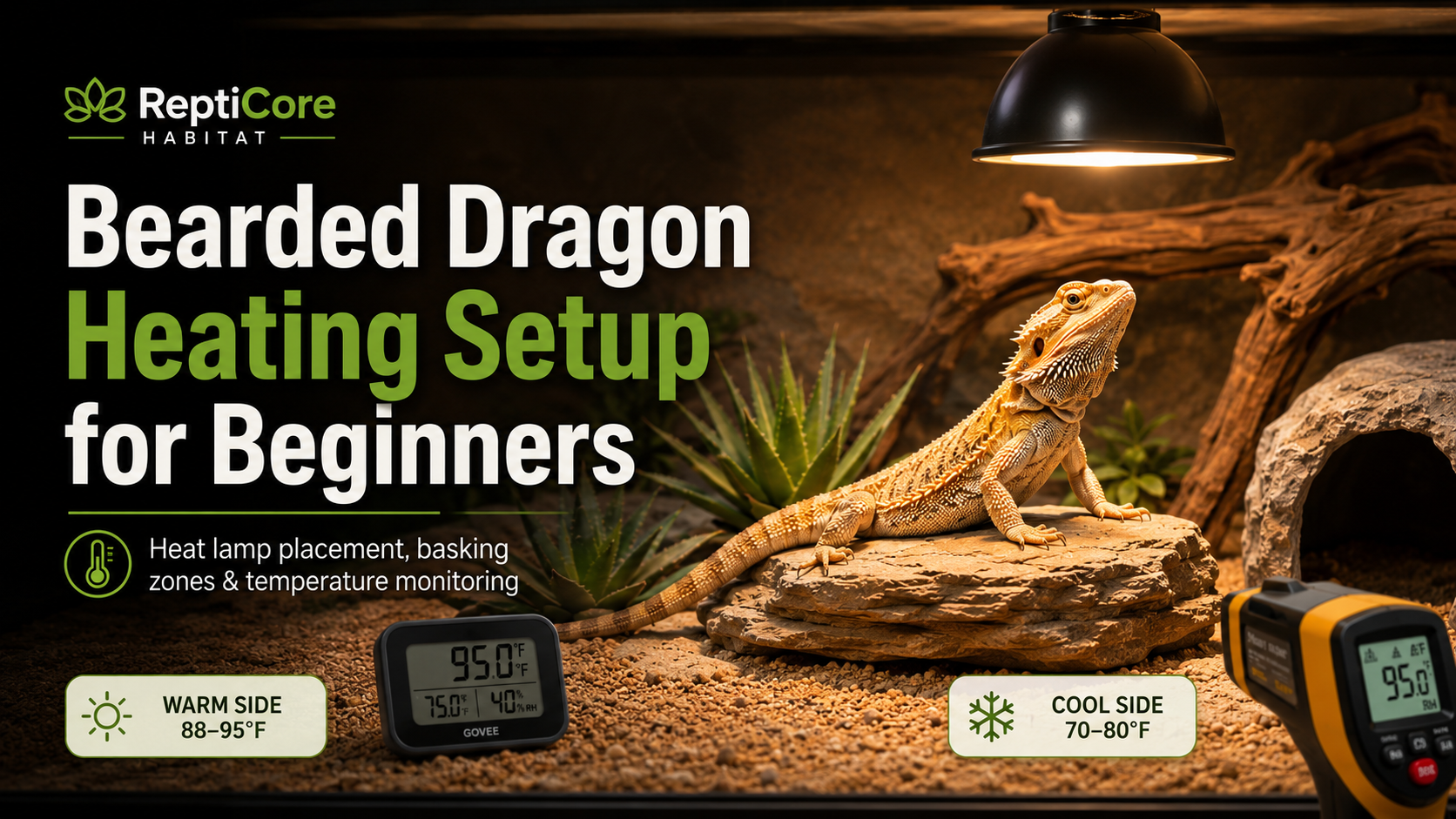
Setting up heat for a bearded dragon can feel confusing at first. New keepers often hear about basking bulbs, UVB lights, thermometers, thermostats, temperature gradients, and nighttime heat, but it is not always clear how those pieces work together.
The goal is not simply to make the enclosure “hot.” A useful heating setup creates a controlled warm side, a cooler retreat, and a reliable way to monitor both air and surface temperatures. UC Davis Veterinary Medicine describes placing a heat lamp above one end of the enclosure to create a warmer side and a cooler side, while the RSPCA bearded dragon care guide likewise emphasizes maintaining a thermogradient.
Quick Answer: What Does a Beginner Heating Setup Need?
| Setup part | Purpose |
|---|---|
| Basking heat bulb | Creates a focused warm basking area |
| Ceramic-socket lamp holder | Supports a compatible heat bulb |
| Warm-side thermometer | Monitors air temperature near the warmer area |
| Cool-side thermometer | Confirms that a cooler retreat remains available |
| Infrared surface thermometer | Checks the basking platform and other surfaces |
| Compatible thermostat or dimming control | Helps manage heat output when used correctly |
| UVB tube and fixture | Provides UVB separately from the heat source |
Heat and UVB are both important, but they are not the same. UC Davis notes that screw-in bulbs can provide heat without providing the required UVB. For the broader enclosure workflow beyond heating, see How to Set Up a Bearded Dragon Tank for Beginners.
1. Start With the Temperature Gradient
A bearded dragon enclosure should have a warm basking side and a cooler side. The warm side provides the basking zone; the cool side gives the animal somewhere to move away from the heat.
A beginner-friendly arrangement commonly includes:
- The heat lamp above one end of the enclosure
- A stable rock, branch, slate, or platform beneath the lamp
- A properly selected UVB tube positioned for the intended basking zone
- A thermometer monitoring the warm side
- A thermometer monitoring the cool side
- An infrared thermometer for surface checks
Temperature recommendations vary according to what is being measured, including basking-surface temperature, warm-side air temperature, and cool-side temperature. Use the dedicated guide What Temperature Does a Bearded Dragon Need? for the detailed ranges rather than treating one number as universal.
2. Use Controlled Overhead Heat
Bearded dragons are basking reptiles. A white basking bulb or suitable halogen-style heat bulb is commonly positioned above one end of the enclosure to create focused daytime warmth.
SPCA New Zealand advises against heat mats and heat rocks for bearded dragons and recommends creating both a warm side and a cool side. A practical beginner approach is to:
- Use an overhead basking heat lamp.
- Provide a stable basking platform beneath it.
- Keep a cooler retreat at the opposite end.
- Measure the result instead of judging heat by brightness or touch.
3. Choose a Heat-Safe Lamp Holder
Basking bulbs generate substantial heat, so the holder should be designed for compatible heat bulbs and should usually use a ceramic socket. Do not rely on an ordinary household fixture that is not rated for the bulb and intended use.
Before installation, check:
- Socket and bulb compatibility
- The fixture’s wattage limit
- Lamp stability and mounting
- Distance from the basking surface
- Clearance from décor, moisture, and combustible materials
- Whether the animal can contact the hot fixture or bulb
The RSPCA advises maintaining suitable distance between the animal and lamp and using a guard where needed. Always follow the fixture and bulb manufacturer’s installation instructions.
4. Measure the Basking Surface, Not Just the Air
One of the most common beginner mistakes is measuring only air temperature. A rock, slate, branch, or platform directly beneath the lamp can become warmer than the surrounding air.
Use different tools for different measurements:
- Use digital thermometers to monitor enclosure air temperatures.
- Use an infrared surface thermometer for basking-platform and other surface checks.
PetMD’s bearded dragon care sheet recommends monitoring both warm and cool zones and notes that a digital infrared thermometer can quickly measure surface temperatures.
A simple testing routine is:
- Turn on the complete daytime lighting and heating setup.
- Allow the enclosure to warm and stabilize.
- Read the warm-side air temperature.
- Read the cool-side air temperature.
- Check the basking surface with an infrared thermometer.
- Adjust lamp distance, compatible control settings, or platform height as needed.
5. Monitor Both Ends of the Enclosure
A single reading cannot describe the entire enclosure. At minimum, monitor the warm side and the cool side so you can confirm that the habitat provides a usable gradient instead of remaining too warm or too cool throughout.
Probe thermometers can monitor selected air-temperature points, but they should be paired with surface checks beneath the basking lamp. Position and secure probes according to the device instructions so they cannot be moved by the animal.
6. Understand Dimmers and Thermostats
A manual dimmer and an automatic thermostat are not the same.
- A manual dimmer lets the keeper increase or reduce lamp output manually.
- A compatible thermostat regulates output according to feedback from its temperature probe.
The RSPCA recommends thermostat regulation together with independent temperature checks. Even when a thermostat is used, verify the enclosure with separate thermometers. A controller probe measures one selected location and does not confirm every surface or the entire gradient.
7. Coordinate Heat With UVB
Heat and UVB should work together around an appropriate basking zone, but they remain separate parts of the setup. UVB placement depends on the specific tube, reflector, output, distance, mesh, and enclosure layout.
The RSPCA notes that UVB does not pass through glass. ReptiFiles’ lighting and temperature guidance also explains that distance and mesh influence UVB exposure. Follow the lamp manufacturer’s instructions and current species-specific guidance.
For a focused explanation, read Do Bearded Dragons Need UVB Lighting?.
8. Plan for Nighttime Conditions
Visible basking lights should not remain on overnight. Bearded dragons benefit from a clear day-and-night cycle.
If the room remains within the nighttime guidance you are following, extra heat may not be needed. If the room becomes too cold, use an appropriate non-light-emitting heat source with compatible control and continue monitoring temperatures. Do not use a bright basking lamp overnight.
Common Beginner Heating Mistakes
Putting the heat source in the middle
A centrally placed lamp can make it harder to establish distinct warm and cool zones. Position the primary basking heat source toward one end.
Measuring only air temperature
Air and surface temperatures are different. Check the actual basking surface with an appropriate infrared thermometer.
Relying on heat rocks or heat mats
These are not recommended as the primary heating method for bearded dragons. Build the daytime warm side around controlled overhead heat.
Forgetting the cool side
The cooler retreat is part of the heating plan. Confirm it remains available after the daytime equipment has stabilized.
Assuming one bulb wattage works everywhere
A bulb that works in one setup may run too warm or too cool in another. Enclosure size, room temperature, ventilation, mesh, lamp distance, basking-surface material, and platform height all influence the result.
Treating a manual dimmer as an automatic thermostat
A manual dimmer changes output only when the keeper adjusts it. It does not automatically regulate temperature.
Forgetting that UVB is separate
A heat bulb does not replace a suitable UVB system. Plan and test both parts of the basking zone according to the equipment and enclosure.
A Simple Beginner Heating Setup Checklist
Before regular use, check that the heating and monitoring portion of the setup includes:
- An overhead basking heat bulb
- A compatible heat-safe lamp holder
- A stable basking platform
- A defined warm side and cool side
- A digital thermometer monitoring the warm side
- A digital thermometer monitoring the cool side
- An infrared thermometer for surface checks
- UVB lighting selected and positioned separately
- A clear day-and-night lighting schedule
- No exposed hot surfaces the animal can contact
- Tested readings before the animal relies on the setup
Set up the equipment first, test carefully, and then adjust it before regular use. Recheck conditions after changes to enclosure size, room temperature, ventilation, lamp distance, basking surface, bulb, or fixture placement.
What the Starter Kit Covers
The ReptiCore Habitat starter kit includes a 75W white basking heat bulb, adjustable ceramic-socket clamp lamp, 24W T5 HO UVB 10.0 tube, aluminum reflector fixture, and two digital probe thermometers for warm-side and cool-side monitoring.
It does not include the enclosure, substrate, hides, basking platform, food dish, water dish, décor, supplements, infrared temperature gun, automatic thermostat, or live animal. The included dimmer is manually controlled and is not an automatic thermostat.
Need a more organized starting point? Review the Bearded Dragon Heating & UVB Starter Kit for the heat, UVB, and monitoring portion of the setup. Test and adjust every enclosure before regular use.
Frequently Asked Questions
What heat source is commonly used in a beginner bearded dragon setup?
A common starting point is an overhead white basking bulb or suitable halogen-style heat bulb positioned above one end of the enclosure. The aim is to create a controlled warm basking zone and preserve a cooler retreat.
Where should I place the heat lamp?
Place it above one end rather than in the center. Final placement depends on enclosure size, ventilation, room temperature, lamp distance, basking-platform height, and the readings you obtain during testing.
Do I need thermometers on both sides?
Yes. Monitoring the warm and cool sides helps you assess the overall gradient instead of relying on a single point.
Do I need an infrared thermometer?
It is strongly recommended for quick basking-surface checks. Digital probe thermometers monitor selected air-temperature points, while an infrared thermometer checks surfaces. The ReptiCore starter kit does not include an infrared temperature gun.
Is a heat lamp the same as a UVB light?
No. A heat lamp provides warmth, while a UVB lamp provides ultraviolet exposure. Both need to be selected and positioned for their specific purpose.
Can I use a heat mat for a bearded dragon?
Heat mats and heat rocks are not recommended as the primary heating method for bearded dragons. A controlled overhead basking source is a more appropriate beginner approach.
Should the heat lamp stay on at night?
Visible heat lamps should not remain on overnight. If nighttime heat is needed because the room becomes too cold, use an appropriate non-light-emitting source with compatible control and monitor conditions carefully.