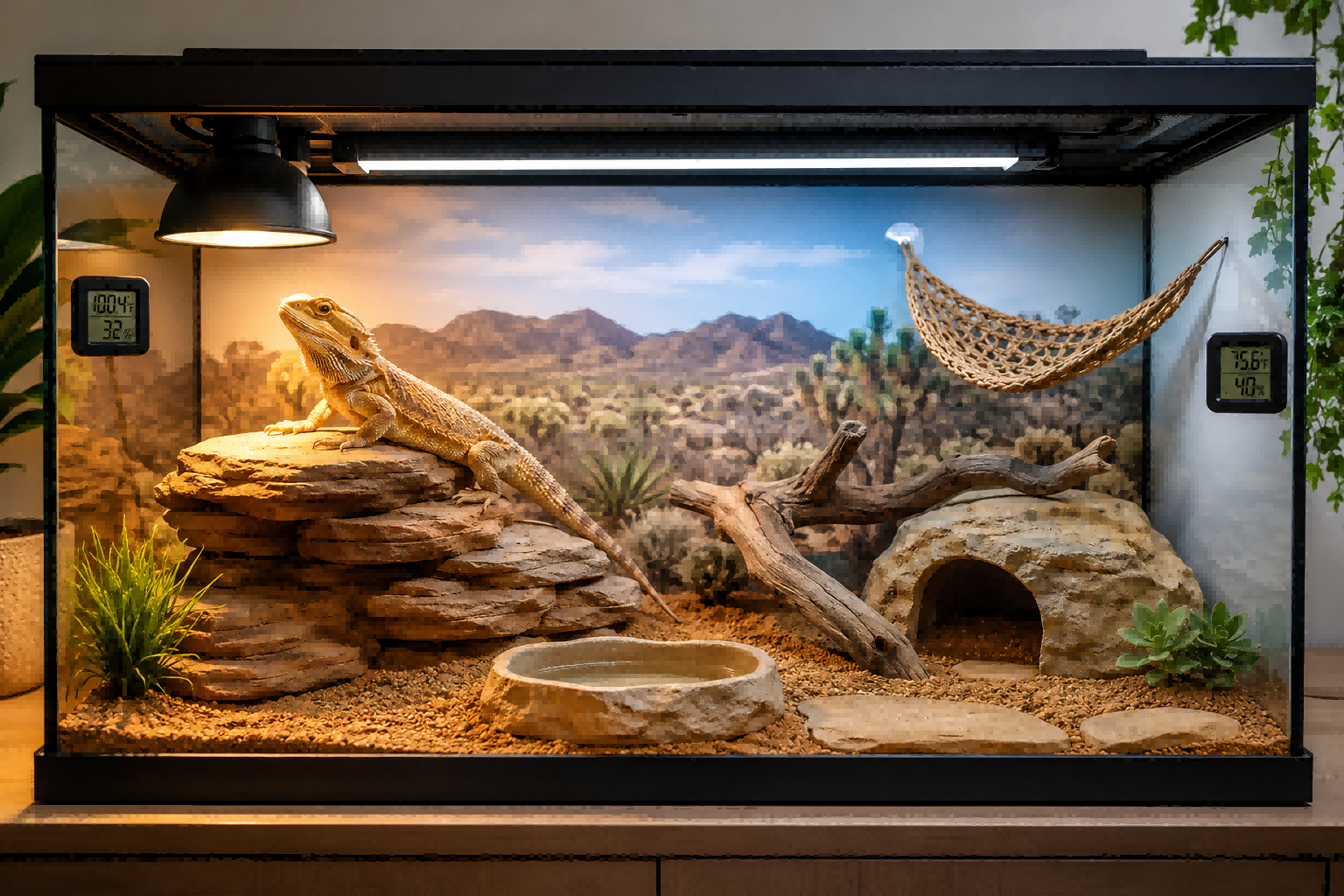
Bringing home a bearded dragon is exciting, but the enclosure should be fully prepared before the animal arrives.
A good setup is not simply a tank with a heat bulb. Your bearded dragon needs a usable temperature gradient, strong UVB exposure, a bright basking area, a cooler shaded retreat, low ambient humidity, secure climbing surfaces and enough room to move naturally.
This guide walks through the setup in the order that makes the most sense for a beginner.
Important: Set up and test the complete enclosure for at least 24–48 hours before introducing your bearded dragon. Equipment performance changes with room temperature, enclosure material, ventilation, mesh density and mounting distance.
Bearded Dragon Tank Setup Checklist
Before your bearded dragon comes home, prepare:
- A secure adult-sized enclosure
- A bright daytime basking heat source
- A thermostat compatible with the heat source
- A high-output linear UVB tube and reflector
- A timer for the daily light cycle
- A thermometer for the basking area
- A thermometer for the cool end
- An infrared surface thermometer
- A hygrometer at the cool end
- A stable basking stone or slate
- At least one secure hide, ideally with shelter available across the gradient
- Safe substrate
- Secure branches or low climbing structures
- A shallow water dish
- Reptile-safe cleaning supplies
The most important principle is to build a gradient, not one uniform environment.
Your bearded dragon should be able to move between heat and shade, stronger and weaker UVB, open basking space and secure shelter.
Step 1: Choose the Right Enclosure Size
A young bearded dragon may look small, but it grows quickly. Starting with an adult-sized enclosure avoids an early upgrade and gives you more room to create stable environmental zones.
For one adult bearded dragon, use an enclosure of at least approximately:
| Measurement | Minimum beginner target |
|---|---|
| Length | 120 cm / 48 in |
| Width | 60 cm / 24 in |
| Height | 60 cm / 24 in |
The enclosure should also be:
- Secure and escape-resistant
- Well ventilated
- Easy to clean
- Able to retain enough heat while still maintaining a cool end
- Large enough for the animal to turn, walk, climb and retreat from the basking area
Place the enclosure away from direct sunlight, radiators, air-conditioning vents and draughty doors. These external heat and cold sources can make the internal temperatures unstable.
Glass, PVC or Wood?
Each material can work when the enclosure is properly designed.
- Glass is easy to view and clean but may lose heat more quickly.
- PVC is lightweight and usually retains heat well.
- Sealed wood can retain heat effectively but must be moisture-resistant and easy to disinfect.
The correct material is less important than whether the finished enclosure can maintain a safe heat, light and ventilation gradient.
Step 2: Create a Warm Side and a Cool Side
Do not place the heat source in the center.
Position it over one end of the enclosure. This creates:
- A bright basking zone
- A warm side
- A middle transition zone
- A cooler shaded end
A useful starting reference is:
| Zone | Starting target |
|---|---|
| Basking surface | 38–42°C / 100–108°F |
| Cool end | 22–26°C / 72–79°F |
| Nighttime minimum | Approximately 20–22°C / 68–72°F |
| Cool-end humidity | Approximately 30–40% RH |
These numbers are not thermostat settings. They are conditions to verify inside the finished enclosure.
The basking surface, warm-side air and cool-side air are different measurements. Always note what you are measuring and where the sensor is positioned.
Use a Visible Daytime Heat Source
Bearded dragons are active during the day and bask under bright heat. A white or natural warm-white halogen-style basking lamp is generally easier to integrate into a natural day cycle than coloured red, blue or purple bulbs.
Choose wattage according to the enclosure—not by guessing from the animal’s age. A lower-output bulb mounted closer can produce a different result from a higher-output bulb mounted farther away.
Regulate the Heat Source
Connect the basking heat source to a compatible thermostat.
The thermostat probe controls the equipment, but it should not be treated as the only temperature measurement. Probe placement can change the reading significantly, and thermostat displays may not match the basking surface.
Use:
- A fixed thermometer near the basking zone
- A second thermometer at the cool end
- An infrared thermometer to verify surfaces
Keep the lamp outside the animal’s reach. When hot equipment is installed inside an enclosure, use a suitable protective guard.
Never use a heated rock as the primary heat source. Concentrated contact heat can create serious burn risk.
Step 3: Install a High-Output Linear UVB System
Heat and UVB perform different jobs. A basking bulb that produces visible light and heat does not automatically provide the UVB exposure a bearded dragon needs.
Use a linear UVB tube with a reflector, positioned toward the basking end so that heat, visible light and UVB overlap.
The goal is to create a UV gradient:
- Strongest exposure in the basking area
- Lower exposure through the middle
- Little or no UVB in the deepest shaded retreat
A commonly referenced target is a UV Index of approximately 3.0–5.0 at the basking position, fading toward zero in shade.
The correct lamp strength and mounting distance depend on:
- The specific UVB product
- Reflector design
- Mesh or screen between the lamp and animal
- Distance to the basking surface
- Enclosure height
- The bearded dragon’s morph and individual needs
Follow the lamp manufacturer’s distance chart and replacement schedule. UVB output decreases with use even when the lamp still appears bright.
Do not rely on sunlight through a window. Glass filters the UVB wavelengths needed in the enclosure.
Create a Consistent Day and Night Cycle
Use a timer so the heat and lights switch on and off consistently.
A simple starting schedule is:
- 12 hours on
- 12 hours off
All visible lights should be off at night.
Additional nighttime heat is only needed when the room becomes too cold. When it is necessary, use a separately controlled, non-light-emitting heat source.
Step 4: Position the Basking Surface Correctly
Place a stable piece of natural slate, stone or another heat-safe textured surface under the basking lamp.
The basking structure should:
- Be wide enough for the dragon’s whole body
- Be stable and unable to collapse
- Provide a textured, non-slip surface
- Remain far enough from the lamp to prevent burns
- Sit within the effective UVB zone
Do not build an unstable stack of loose rocks. Heavy décor should rest securely on the enclosure floor rather than on top of loose substrate.
After the lights have been running long enough to stabilize, use the infrared thermometer to check several points on the basking surface—not only the center.
Step 5: Add Shade, Hides and Climbing Opportunities
A bearded dragon should not be forced to remain exposed all day.
Provide:
- A secure shaded retreat
- Shelter accessible away from the hottest point
- Stable low branches or climbing structures
- Rocks or platforms that allow natural movement
- Open floor space for walking
At least one proper hide is essential. Providing secure shelter across the enclosure gradient gives the animal more control over where it rests.
Branches should be thick enough to support the dragon and fixed so they cannot roll or fall.
Avoid overcrowding. The enclosure should look enriched without becoming difficult to clean or move through.
Step 6: Choose a Beginner-Friendly Substrate
Substrate advice can be confusing because reputable care sources do not always agree about loose sand and soil mixtures.
For a beginner, a simple low-risk starting option is usually easier to monitor and clean:
- Paper towel during quarantine or observation
- Textured stone tile
- Natural slate
- Another solid, non-slip, easy-to-clean surface
This makes it easier to:
- See droppings
- Monitor appetite and digestion
- Keep the enclosure hygienic
- Prevent accidental ingestion while feeding
- Adjust the setup without replacing large amounts of substrate
Healthy adults may later be offered a properly designed digging area or suitable reptile-safe sand/soil mixture when the keeper understands hydration, nutrition, temperatures, cleaning and feeding practices.
Avoid:
- Calcium sand
- Crushed walnut shell
- Gravel
- Corn-cob bedding
- Sharp builder’s sand
- Aromatic wood shavings
- Loose material around unstable heavy décor
Do not place food directly onto loose substrate.
Step 7: Monitor Humidity and Ventilation
Bearded dragons come from dry environments, but “dry” does not mean humidity should be ignored.
Place a hygrometer at the cool end and aim for approximately 30–40% relative humidity as a general starting range.
When humidity remains too high:
- Improve ventilation
- Check whether the water dish is too close to the heat source
- Reduce excessive misting
- Check damp substrate
- Review room humidity
- Confirm the hygrometer is accurate
Do not routinely spray the entire enclosure to create tropical humidity.
At the same time, extremely dry air and poor hydration should not be ignored. Provide fresh water and an appropriate diet, and discuss persistent shedding or skin concerns with a reptile-experienced veterinarian.
Step 8: Add Water and Feeding Areas
Provide a shallow, stable dish of clean water at the cool end.
The dish should:
- Be difficult to tip
- Be easy to remove and clean
- Be shallow enough for safe access
- Not raise enclosure humidity excessively
Replace the water at least daily and whenever it becomes soiled.
Use a separate clean feeding dish for greens. Remove uneaten food promptly, and do not leave loose feeder insects in the enclosure where they may bite or stress the dragon.
This guide focuses on the enclosure. Feeding frequency, supplements and the balance of insects and greens should be planned separately according to age and veterinary guidance.
Step 9: Install and Label the Monitoring Equipment
A beginner setup should make it easy to understand each reading.
Use the equipment as follows:
| Device | What it does | Suggested position |
|---|---|---|
| Thermostat probe | Controls the heat source | Fixed securely at the chosen control point |
| Warm-side thermometer | Measures warm-zone air | Near the basking area, without touching the lamp |
| Cool-side thermometer | Measures cool-zone air | At the shaded end |
| Infrared thermometer | Measures surfaces | Handheld checks of basking stone and other surfaces |
| Hygrometer | Measures ambient humidity | Cool end |
Do not place every sensor in the same location.
Label the warm and cool displays when setting up the enclosure. This reduces confusion during daily checks.
Step 10: Run the Tank Before Your Bearded Dragon Arrives
Do not introduce the animal immediately after switching on the equipment.
Run the enclosure for at least 24–48 hours and record readings at different times.
Pre-Arrival Test
Confirm that:
- The basking surface reaches the intended range
- The cool end remains clearly cooler
- The thermostat reduces heat output as expected
- The UVB and basking zones overlap
- The animal could move fully into shade
- Humidity remains stable
- No hot equipment is accessible
- Lamps and cables are secure
- Heavy décor cannot collapse
- The water dish does not raise humidity excessively
- Temperatures remain safe after several hours of operation
- All visible lights turn off at night
Room temperature may change between day and night, so one quick daytime reading is not enough.
A Simple Beginner Layout
From left to right, the enclosure can follow this general pattern:
Bright warm end
- Basking lamp
- Linear UVB overlapping the basking area
- Stable basking stone
- Warm-side thermometer
- Thermostat control probe
Middle zone
- Branch or low climbing structure
- Open movement space
- Partial shade
Cool shaded end
- Secure hide
- Cool-side thermometer
- Hygrometer
- Shallow water dish
This arrangement is a starting framework, not a rigid design. The finished setup must be verified with actual readings.
Common Bearded Dragon Tank Setup Mistakes
1. Buying a Tank That Will Be Outgrown Quickly
A small starter tank may save space briefly but makes it harder to create stable heat and light gradients.
2. Using Heat Without a Thermostat
A lamp’s output can change with room temperature, mounting distance and ventilation. Regulation and independent verification are both needed.
3. Treating the Thermostat Display as the Basking Temperature
The thermostat probe measures only its exact location. Use an infrared thermometer to check the basking surface.
4. Using a Small UVB Bulb in One Corner
Bearded dragons benefit from a broad UVB-lit basking area and a usable light-to-shade gradient. A linear tube is generally better suited to this layout.
5. Placing UVB Above Glass
UVB does not pass effectively through glass. The lamp must be installed according to its design and manufacturer instructions.
6. Using Coloured Night Bulbs
Visible light at night disrupts a normal dark period. Use a non-light-emitting heat source only when nighttime temperatures require it.
7. Filling the Enclosure Before Testing It
A setup can look correct and still run too hot, too cold or too humid. Test it before the animal arrives.
8. Using Unstable Rocks or Branches
Bearded dragons climb and dig. Every heavy item must be secure.
9. Ignoring the Cool End
The cool retreat is not optional. The dragon needs to move away from heat and UVB.
10. Assuming One Setup Works in Every Home
Room temperature, climate, air conditioning and enclosure construction all affect performance. Measure the finished environment rather than copying another keeper’s thermostat number.
Need a Simpler Starting Point?
The Bearded Dragon Heating & UVB Starter Kit combines the core heat, UVB and monitoring components used to build the environmental foundation described in this guide.
Explore the Bearded Dragon Heating & UVB Starter Kit
You will still need an appropriately sized enclosure, basking surface, hides, substrate, water dish and other habitat furnishings.
You can also browse the full Bearded Dragon Setup collection.
Frequently Asked Questions
What size tank does an adult bearded dragon need?
A practical minimum starting point for one adult is approximately 120 × 60 × 60 cm, or 48 × 24 × 24 inches. Larger enclosures can provide more usable space when heat and UVB gradients are maintained correctly.
What temperature should a bearded dragon basking spot be?
A commonly used starting target is approximately 38–42°C, or 100–108°F, at the basking surface. Always distinguish surface temperature from surrounding air temperature.
How cool should the cool side be?
A general starting range is approximately 22–26°C, or 72–79°F. The important point is that the dragon has a clearly cooler retreat from the basking zone.
Do bearded dragons need UVB?
Yes. Bearded dragons are diurnal lizards and require appropriate UVB exposure to support vitamin D3 production and calcium regulation.
Can UVB pass through a glass tank lid?
No. Glass filters UVB. Install the UVB system according to the lamp manufacturer’s instructions and ensure the intended UVB reaches the basking position.
Should the heat lamp stay on at night?
No visible basking lamp should remain on overnight. Use a non-light-emitting heat source with separate thermostat control only when nighttime room temperatures fall below the safe range.
What humidity should a bearded dragon tank have?
A common cool-end target is approximately 30–40% RH. Monitor with a hygrometer and adjust ventilation and moisture sources when necessary.
Is sand safe for a bearded dragon?
Guidance varies. Beginners can reduce complexity by starting with paper towel, textured tile or slate. A carefully prepared digging area or suitable sand/soil mix may be considered later for a healthy adult after the rest of the husbandry is stable.
How long should I test the tank before adding the dragon?
Run the complete setup for at least 24–48 hours. Check temperatures and humidity at different times rather than relying on one reading.
Can I keep two bearded dragons in one enclosure?
Bearded dragons are generally best housed separately. Cohabitation can lead to competition, stress and injury, even when obvious fighting is not seen.
Final Check Before Bringing Your Bearded Dragon Home
Your enclosure is ready when you can answer “yes” to all of these:
- Is the enclosure large enough for an adult?
- Is the heat source positioned at one end?
- Is the heat source regulated by a compatible thermostat?
- Is the basking surface independently measured?
- Is the cool end independently measured?
- Does the UVB overlap the basking area?
- Is there a shaded retreat?
- Is humidity being monitored?
- Are all lamps, probes and cables secured?
- Are the substrate and décor easy to clean and stable?
- Has the enclosure run safely for 24–48 hours?
- Do you know which items still need to be added?
A well-designed tank gives your bearded dragon choices: warm or cool, bright or shaded, active or hidden. That ability to choose is the foundation of a safer and more functional habitat.
This guide provides general setup information and does not replace individual advice from a reptile-experienced veterinarian. Equipment specifications, mounting distances and replacement schedules should always follow the manufacturer’s instructions.