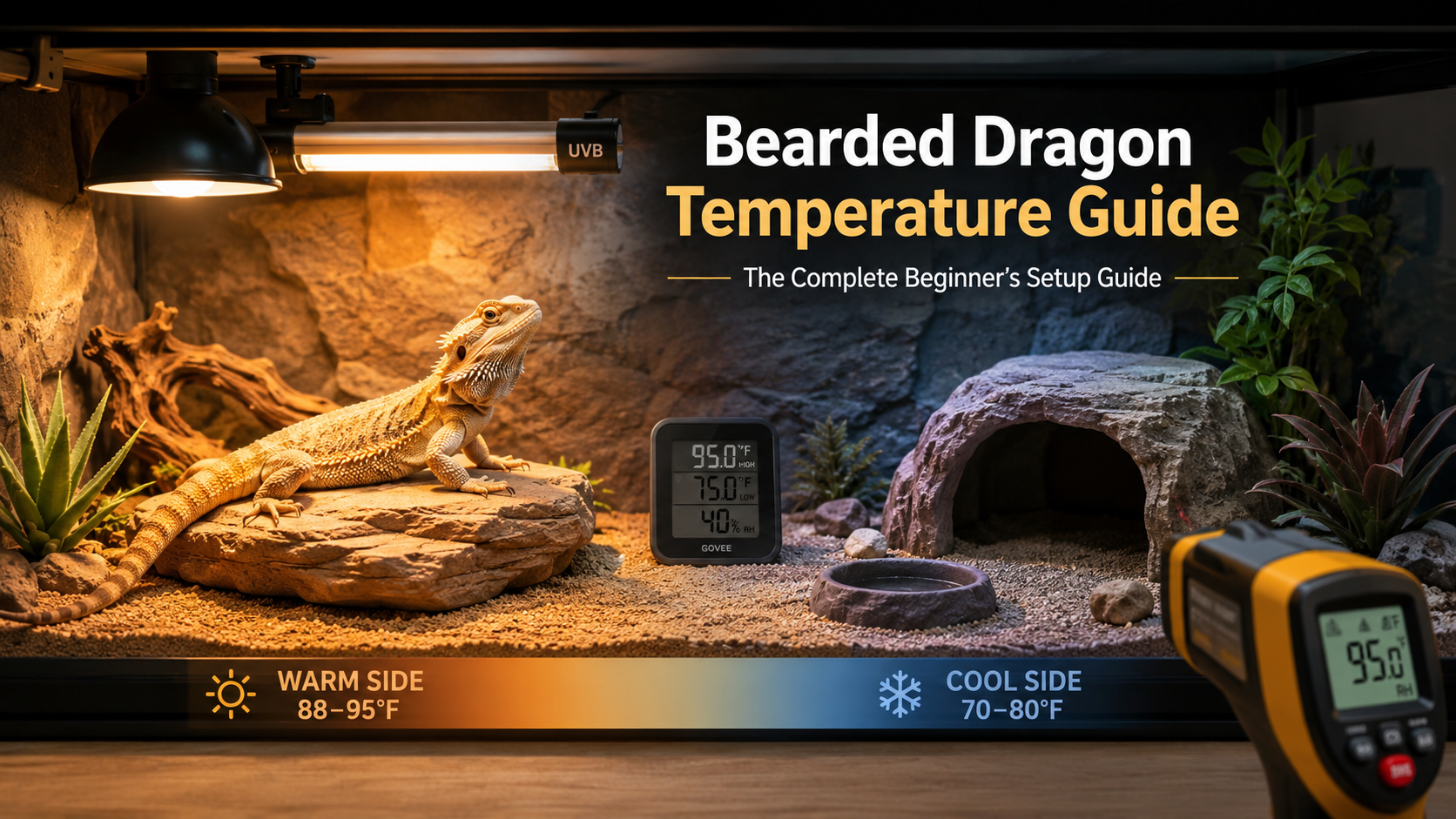
Getting the temperature right is one of the most important parts of setting up an appropriate bearded dragon habitat.
Bearded dragons are ectothermic reptiles, which means they rely on their environment to warm up, cool down, digest food, and regulate daily activity. A suitable setup should not stay at one temperature throughout the enclosure. Instead, it should create a temperature gradient: a warm basking area on one side and a cooler retreat on the other. The RSPCA bearded dragon care guide explains that reptiles use their environment to warm up and cool down, making a thermogradient essential in the vivarium.
This guide breaks down the basic temperature zones a beginner should understand before setting up a bearded dragon enclosure.
Quick Answer: Bearded Dragon Temperature Chart
Use these ranges as beginner-friendly starting points, then adjust and verify the enclosure based on the animal, equipment, measurement method, and qualified care guidance.
| Habitat area | Suggested range |
|---|---|
| Basking surface | About 100–113°F / 38–45°C |
| Warm-side air temperature | Around 90–99°F / 32–37°C |
| Cool side | About 75–85°F / 24–29°C |
| Nighttime | Often around 65–75°F / 18–24°C, depending on room conditions |
Different care guides may list slightly different target ranges because they may be measuring different things: surface temperature, air temperature, hot-end temperature, or nighttime room temperature. ReptiFiles recommends a basking surface temperature of 108–113°F and a cool-side surface temperature of 77–85°F, while the RSPCA lists a hotter bright end of 38–42°C and a cooler shaded end of 22–26°C.
The most important takeaway: your bearded dragon needs a warm basking area, a cooler escape area, and reliable temperature monitoring.
Why Bearded Dragons Need a Temperature Gradient
A bearded dragon should be able to move between warmer and cooler areas throughout the day.
If the entire enclosure is too hot, your dragon has nowhere to escape the heat. If the entire enclosure is too cool, your dragon may struggle to warm up properly for activity and digestion. ReptiFiles notes that bearded dragons need a temperature gradient so they can regulate body temperature, with the highest temperatures on one side and lower temperatures on the opposite side.
A simple setup usually includes:
- A basking heat source on one side
- A UVB light positioned according to the lamp manufacturer's guidance and the enclosure layout
- A cooler shaded end
- A thermometer on the warm side
- A thermometer on the cool side
- An infrared thermometer for surface temperature checks
Basking Surface Temperature vs. Air Temperature
This is where many beginners get confused.
A basking surface is the rock, branch, slate, or platform directly under the heat lamp. This surface can become warmer than the air around it, so you should not rely only on the air temperature.
- A digital probe thermometer can help monitor air temperature.
- An infrared thermometer can help check the basking surface temperature.
PetMD's bearded dragon care sheet recommends monitoring both warm and cool zones with thermometers and notes that a digital infrared thermometer can be used to measure surface temperatures quickly.
What Should the Basking Area Temperature Be?
For many beginner setups, the basking surface is generally kept within the 100–113°F / 38–45°C range.
Some care guides use a slightly lower hot-end range, while others recommend a higher basking surface target. The difference is often related to the measurement method. A surface temperature measured with an infrared thermometer will not always match the air temperature measured by a probe thermometer.
A practical beginner approach is to:
- Create a warm basking zone under the heat lamp.
- Check the surface temperature with an infrared thermometer.
- Monitor the surrounding warm-side air temperature with a digital thermometer.
- Adjust bulb wattage, lamp distance, or compatible thermostat settings as needed.
Do not place the lamp too close to your bearded dragon. The RSPCA advises that the dragon's back should not get closer than 25–30 cm from the lamp and recommends using a thermostat together with infrared thermometer checks.
What Temperature Should the Cool Side Be?
The cool side gives your bearded dragon a place to escape the heat.
A common beginner target is around 75–85°F / 24–29°C. ReptiFiles lists the cool-side surface temperature as 77–85°F, while the RSPCA describes the cooler shaded end as 22–26°C.
The cool side should not be ignored. If it gets too warm, your dragon may not be able to move away from the heat effectively. If it gets too cold during the day, the overall enclosure may not support normal daily activity.
What Temperature Does a Bearded Dragon Need at Night?
Bearded dragons do not need bright heat lamps at night. They benefit from a normal day-and-night cycle, so visible lights should be turned off after the daytime period.
Nighttime temperature guidance varies. The RSPCA says the temperature should not drop below 20–22°C at night, while ReptiFiles notes that healthy bearded dragons may tolerate lower nighttime drops when daytime temperatures are correct.
A cautious beginner approach is to:
- Turn off visible lights at night.
- Avoid placing the enclosure in a cold or drafty room.
- Use a properly controlled, non-light-emitting heat source only if the room gets too cold.
- Ask a reptile veterinarian or experienced reptile specialist if nighttime temperatures fall outside the guidance you are following.
Do not use bright basking bulbs overnight because they can disrupt the bearded dragon's light cycle.
How to Measure Bearded Dragon Temperatures Correctly
A useful monitoring routine measures both air temperature and surface temperature.
Use digital thermometers for air temperature
Place one thermometer on the warm side and one on the cool side so you can monitor the enclosure gradient.
Use an infrared thermometer for surfaces
Use it to check:
- The basking rock or slate
- Branches beneath the heat source
- Warm-side surfaces
- Potential hot spots under the lamp
Use a compatible thermostat or dimming controller
A compatible thermostat or dimming controller can help regulate heat output and reduce temperature swings. SPCA New Zealand recommends a basking spot regulated by a dimming thermostat so it does not get too hot or too cold.
Planning the heating, UVB, and monitoring portion of your setup? The Bearded Dragon Heating & UVB Starter Kit offers a coordinated starting point for those parts of the enclosure. It is not a complete habitat and does not replace species-specific research or qualified care advice.
Common Beginner Temperature Mistakes
Mistake 1: Measuring only one spot
One thermometer is not enough to understand the whole enclosure. You need to know both the warm-side and cool-side conditions.
Mistake 2: Confusing air temperature with surface temperature
A basking rock can be much hotter than the surrounding air. Check surfaces separately with an appropriate infrared thermometer.
Mistake 3: Using the wrong heat source
Heat mats and heat rocks are not recommended for bearded dragons. SPCA New Zealand warns against them because they can cause injuries. Bearded dragons are basking reptiles and generally need overhead heat.
Mistake 4: Forgetting UVB
Heat alone is not the entire lighting setup. Bearded dragons also need properly selected and positioned UVB lighting to support vitamin D3 production and calcium use. Follow current species-specific guidance and the UVB manufacturer's installation instructions.
Mistake 5: Not checking temperatures regularly
Room temperature, bulb age, enclosure ventilation, lamp distance, and seasonal changes can all affect the setup. Make temperature checking part of your regular routine.
A Simple Beginner Heating Setup
The heating, UVB, and monitoring portion of a beginner bearded dragon setup commonly includes:
- A basking heat lamp
- A compatible lamp holder
- A properly selected linear UVB tube and reflector fixture
- A warm-side thermometer
- A cool-side thermometer
- An infrared thermometer
- A compatible thermostat or dimming control
- A suitable basking surface
- Enough enclosure space for a warm-to-cool gradient
The goal is not simply to make the enclosure “hot.” The goal is to create a habitat where your bearded dragon can move between useful temperature zones.
Need Help Starting Your Setup?
The ReptiCore Habitat Bearded Dragon Heating & UVB Starter Kit is designed to help beginners organize the heat, UVB lighting, and temperature-monitoring portion of a bearded dragon habitat with less guesswork.
It does not include the enclosure, substrate, hides, feeding supplies, décor, or live animal, and it does not replace proper research, species-specific care guidance, or reptile veterinarian advice. It provides a clearer starting point for one important part of enclosure planning: heat, UVB, and monitoring.
Frequently Asked Questions
What is the best basking temperature for a bearded dragon?
Many beginner care guides place the basking area around 100–113°F / 38–45°C, depending on whether they are describing air temperature or surface temperature. Confirm which measurement a source is referring to before comparing numbers.
Should I measure air temperature or surface temperature?
Measure both. Digital thermometers help monitor air temperature on the warm and cool sides, while an infrared thermometer helps check basking surfaces and potential hot spots.
What temperature should the cool side be?
A common starting target is about 75–85°F / 24–29°C, although some care guides describe the cooler shaded end slightly differently. The important point is to maintain a usable gradient and monitor it consistently.
Do bearded dragons need heat at night?
They usually do not need visible light at night. If the room becomes colder than the nighttime guidance you are following, use an appropriately controlled, non-light-emitting heat source and continue monitoring the enclosure.
Do bearded dragons need UVB as well as heat?
Yes. Heat and UVB serve different roles in the habitat. Bearded dragons need a suitable basking heat source as well as properly selected and positioned UVB lighting.
Can I use a heat mat for a bearded dragon?
Heat mats and heat rocks are generally not recommended for bearded dragons. They are basking reptiles that typically need overhead heat, and SPCA New Zealand warns that heat mats and heat rocks can cause injuries.