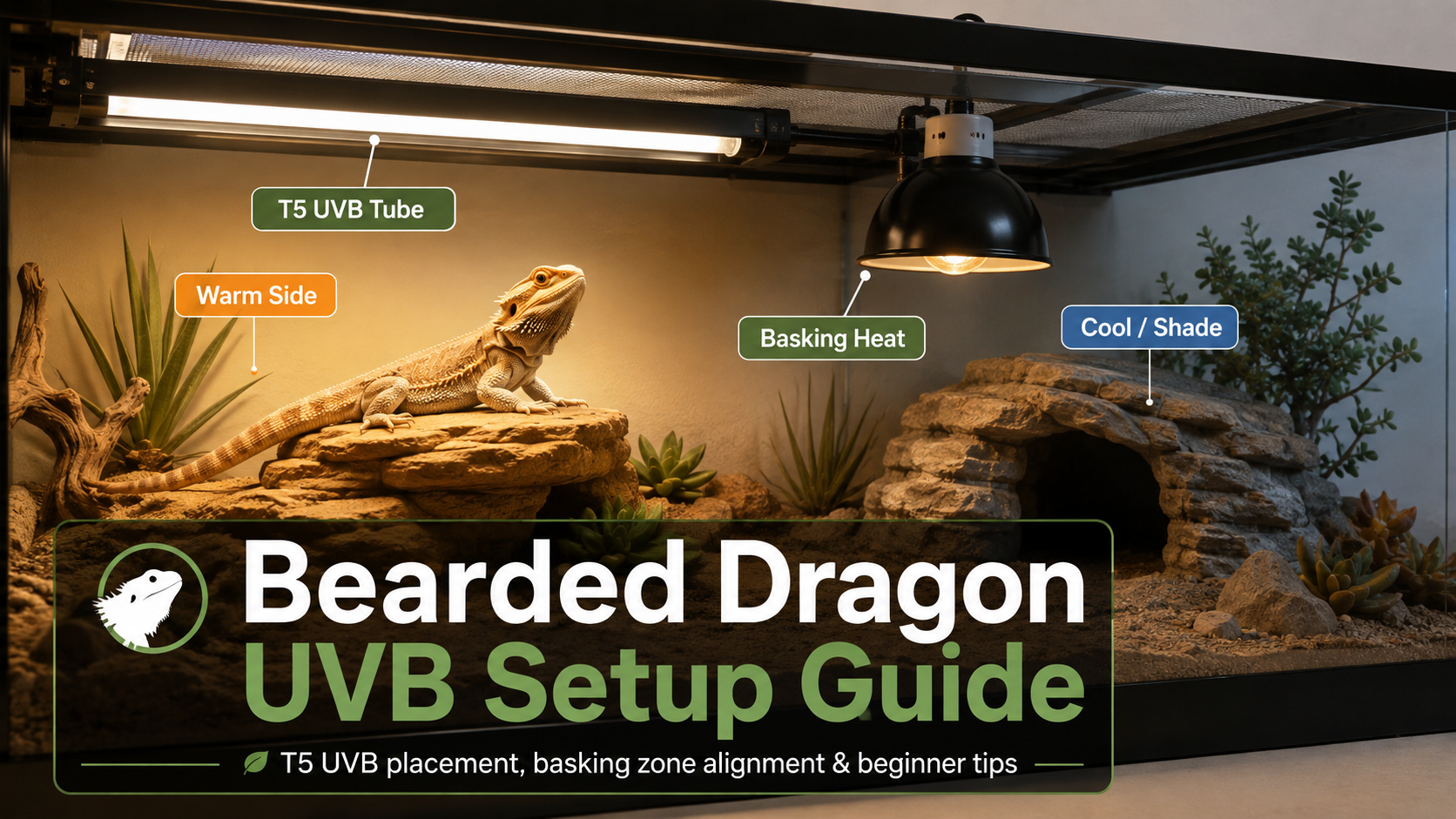
Setting up UVB lighting is one of the most important parts of a bearded dragon habitat, but it is also one of the easiest areas for beginners to misunderstand.
A bearded dragon needs more than a warm enclosure. Heat, UVB, visible light, shade, and temperature monitoring should work together around a usable basking zone. Heat and UVB are related parts of the habitat, but they are not interchangeable.
This guide focuses on the setup itself: choosing a linear tube and reflector, aligning UVB with the basking area, accounting for distance and mesh, planning shade, setting a schedule, and knowing when to replace the lamp. For the shorter explanation of why UVB is required, read Do Bearded Dragons Need UVB Lighting?.
Quick Answer: What UVB Setup Does a Bearded Dragon Need?
| Setup part | Purpose |
|---|---|
| Linear T5 HO UVB tube | Provides UVB across part of the enclosure |
| Compatible reflector fixture | Directs UVB downward toward the intended zone |
| Basking heat lamp | Provides warmth separately from UVB |
| Stable basking platform | Creates an accessible heat-and-UVB zone |
| Shade and hides | Allow movement into lower-light areas |
| Timer | Maintains a consistent day-and-night schedule |
| Temperature-monitoring tools | Confirm the warm and cool sides independently of UVB |
For many modern beginner setups, a linear T5 HO UVB tube is preferred over a small compact bulb because it can provide broader coverage around the basking area. The RSPCA bearded dragon care guide recommends a high-output fluorescent UVB tube positioned toward the hot end and emphasizes providing a gradient from light to shade.
UVB Is Not the Same as Heat
A basking heat bulb creates warmth. A UVB tube provides ultraviolet exposure. One does not replace the other.
UC Davis Veterinary Medicine notes that screw-in bulbs, including some marketed as “full spectrum,” may provide heat without providing UVB. A typical indoor setup therefore plans the overhead heat source and the UVB system separately, then aligns them around the basking zone.
For the heat-lamp workflow, lamp placement, and monitoring routine, see Bearded Dragon Heating Setup for Beginners.
Choose a Linear T5 HO UVB Tube
A practical beginner direction is a linear T5 HO UVB tube installed in a compatible reflector fixture. The reflector and tube should be designed to work together.
A small compact or coil bulb may illuminate only a limited area and should not be assumed to provide suitable coverage for a standard bearded dragon enclosure. ReptiFiles’ bearded dragon lighting guidance discusses linear T5 HO options and explains that final exposure depends on lamp output, distance, and obstruction from mesh.
Do not select a lamp by percentage or marketing label alone. Check the specific bulb, fixture, reflector, enclosure height, planned basking distance, and manufacturer instructions as one system.
Place UVB Near the Basking Zone
The UVB tube should not be positioned randomly. The stronger UVB area should generally overlap the daytime basking zone so the animal can access warmth and UVB in the same part of the enclosure.
A simple layout often includes:
- The heat lamp above one end of the enclosure
- The linear UVB tube above or near the same basking side
- A stable platform beneath the coordinated heat-and-UVB zone
- A cooler, shaded area at the opposite end
- No glass or plastic barrier between the UVB lamp and the animal
Placing heat on one end and UVB only on the opposite end can force the animal to choose between warmth and UVB. Alignment should still follow the tube and fixture manufacturer’s distance and mounting instructions.
Create a UVB Gradient
The goal is not one flat UVB level across the entire enclosure. A bearded dragon should be able to move between stronger light near the basking zone and lower-light or shaded areas.
The RSPCA describes a gradient with higher UVB around the basking area and little or no UVB in shade. The practical setup steps are:
- Position the UVB tube toward the warm side.
- Provide shade and suitable hides.
- Avoid covering the whole enclosure with the strongest exposure.
- Leave room for the animal to choose between light and shade.
- Follow the bulb and fixture manufacturer’s placement guidance.
Account for Distance, Mesh, and Enclosure Height
UVB setup is not determined by bulb strength alone. A tube that is too far from the basking platform may provide less exposure than intended, while a strong lamp placed too close may create excessive exposure. Mesh can reduce output before it reaches the basking area.
Before finalizing placement, document:
- The exact UVB tube model and output
- The fixture and reflector type
- The distance from the tube to the basking surface
- Whether the lamp is mounted above or below mesh
- The mesh density
- The enclosure height
- The basking-platform height
- The manufacturer’s recommended mounting range
A UV Index meter provides the most direct way to assess UVB at the basking position. Without one, follow current species-specific guidance and the exact lamp and fixture instructions rather than guessing from brightness.
Do Not Put UVB Behind Glass or Plastic
Glass and plastic block useful UVB. Sunlight through a closed window does not replace a reptile UVB lamp, and a UVB tube behind a clear barrier may look bright without delivering the intended exposure.
For a beginner setup:
- Do not rely on sunlight through a window.
- Do not place glass or plastic between the UVB tube and the basking area.
- Account for any mesh lid in the placement plan.
- Follow the fixture and bulb instructions carefully.
Use a Consistent Day-and-Night Schedule
Bearded dragons need a clear day-and-night cycle. A common beginner schedule uses approximately 10–12 hours of daytime UVB and visible light, followed by lights off at night.
PetMD’s bearded dragon care sheet recommends a consistent period of daytime UVB. A timer or smart plug can make the daily schedule easier to maintain.
Do not leave bright lights on overnight. If room conditions require nighttime heat, use an appropriate non-light-emitting source with compatible control and continue monitoring temperatures.
Replace UVB Lamps on Schedule
UVB output decreases over time even when a lamp still produces visible light. Brightness alone cannot confirm useful UVB output.
Record the installation date and follow the UVB tube manufacturer’s replacement schedule. If you have access to a UV Index meter, use it to assess output at the basking position and after changes to the lamp, fixture, mesh, or basking-platform height.
Beginner UVB Setup Checklist
Before relying on the enclosure for regular use, confirm that:
- A linear T5 HO UVB tube is installed in a compatible reflector fixture.
- The tube is aligned with the intended basking zone.
- The heat lamp and UVB system overlap appropriately on the warm side.
- The tube-to-basking-surface distance follows the manufacturer’s instructions.
- Mesh obstruction and enclosure height have been considered.
- No glass or plastic blocks the UVB path.
- Shade and hides remain available.
- A consistent day-and-night schedule is set.
- The lamp’s installation and replacement dates are recorded.
- Warm-side and cool-side temperatures are checked separately.
- The basking surface is checked with an infrared thermometer.
- The complete enclosure is tested before regular use.
Set up UVB, heat, shade, and monitoring together, then test the finished enclosure. Recheck after changing the bulb, fixture, mesh, enclosure, lamp distance, or basking platform.
Common Beginner UVB Mistakes
Thinking the heat bulb provides UVB
Most basking bulbs provide heat and visible light, not the UVB exposure supplied by a suitable reptile UVB system.
Using a small compact bulb as the main source
A compact bulb may not provide broad coverage around the basking zone. A linear T5 HO tube and compatible reflector are generally a more practical beginner direction.
Putting UVB only on the cool side
The daytime basking zone should generally offer both warmth and suitable UVB access.
Ignoring mesh
Mesh can reduce UVB, so placement may need to change according to mesh density, fixture type, lamp output, and distance.
Blocking UVB with glass or plastic
A clear barrier may still block UVB even when the enclosure looks brightly lit.
Forgetting shade
The animal should be able to move into lower-light and shaded areas instead of receiving the same exposure everywhere.
Never replacing the lamp
Visible light can remain after useful UVB output has declined. Follow the manufacturer’s replacement schedule.
Copying another enclosure without measuring
A setup that works in one enclosure may not transfer directly to another. Bulb strength, fixture type, distance, mesh, enclosure height, and basking-platform position all affect exposure.
How the ReptiCore Starter Kit Fits Into UVB Setup
The ReptiCore Habitat starter kit includes a 75W white basking heat bulb, adjustable ceramic-socket clamp lamp, 24W T5 HO UVB 10.0 tube, aluminum reflector fixture, and two digital probe thermometers.
It supports the heat, linear UVB, and temperature-monitoring portion of a beginner setup. It does not include the enclosure, substrate, hides, basking platform, food dish, water dish, décor, supplements, infrared temperature gun, automatic thermostat, or live animal. The included dimmer is manually controlled and is not an automatic thermostat.
Use What Temperature Does a Bearded Dragon Need? when testing the warm side, cool side, and basking surface alongside the UVB placement plan.
Ready to review the coordinated components? Visit the Bearded Dragon Heating & UVB Starter Kit. Always follow the UVB tube and fixture manufacturer’s instructions and test the completed enclosure before regular use.
Frequently Asked Questions
What type of UVB light is commonly used for a bearded dragon?
A linear T5 HO UVB tube in a compatible reflector fixture is a common beginner direction because it can provide broader coverage than a small compact bulb. Final selection still depends on the enclosure and manufacturer guidance.
Should UVB be placed near the heat lamp?
The stronger UVB area should generally overlap the daytime basking zone so the animal can access heat and UVB together. Maintain shade and follow the lamp’s distance guidance.
Can a bearded dragon get UVB through a window?
No. Glass blocks useful UVB, so sunlight through a closed window is not a substitute for a correctly installed reptile UVB lamp.
How many hours a day should UVB be on?
A common starting schedule is approximately 10–12 hours during the day, followed by lights off at night. Adjust the schedule according to current care guidance and maintain a consistent cycle.
Does a basking bulb provide UVB?
Most basking bulbs provide heat rather than useful UVB. Plan the basking heat source and UVB system separately.
Does mesh affect UVB?
Yes. Mesh can reduce UVB, and the effect depends on mesh density, distance, lamp output, and fixture design. Follow the manufacturer’s instructions and verify placement where possible.
Do I still need to monitor temperature after setting up UVB?
Yes. UVB placement does not confirm the temperature gradient. Monitor warm-side and cool-side air temperatures and check the basking surface separately.